How To Uncover Product Opportunities: The Perfect Balance Between Ideas and Execution
Ideas are cheap and execution is expensive. Here's how to find the opportunities worth spending execution on.
🚀 Introduction
“Good ideas are everywhere. Execution is what matters.”
You’ve heard this before, right? If you’ve spent any time in product management or entrepreneurship, you’ve probably run into some version of this mantra. But let’s take a step back — is this really true? Yes, execution is critical, but without the right idea, even flawless execution can lead you in the wrong direction.
The truth? Most ideas fail, but not for the reasons people think. Some fail due to execution, sure. But a huge chunk fail because they were never viable in the first place, most of which you will never hear about. We like to dress it up as “failing to find product-market fit,” but really, it’s just another way of saying this idea wasn’t good enough.
And yet, creativity gets a bad rap. People assume you have to sit around waiting for inspiration to strike. But the best product people know creativity can come from structure. A framework can help generate better ideas faster and increase the odds of working on something that actually matters.
That’s what this article is about — how to systematically uncover product opportunities by balancing creativity with execution. I’ll walk you through a structured approach to generating ambitious ideas and gut-checking them before wasting time building something nobody wants.
🤔 Part 1: Why Bad Ideas Happen to Good People
Let’s start with a reality check: not all ideas are created equal.
A great idea with terrible execution? That’s a tragedy. But a bad idea with great execution? That’s just wasted effort and money. Some businesses fail because they couldn’t build fast enough — but many fail because they kept iterating without realizing they were building the wrong thing.
Ideas must come first. They’re the foundation of every product, startup, or feature. But you don’t know if an idea is any good until it’s been tested. The problem? Most people don’t actually test their ideas — they just assume they’re good. With this mindset, every idea seems promising, because there’s no real way to measure its validity.
So how do you generate better ideas without over-investing in ones that won’t work? That’s where The Creative Matrix comes in.
💡 Part 2: Using the Creative Matrix to Generate Ideas
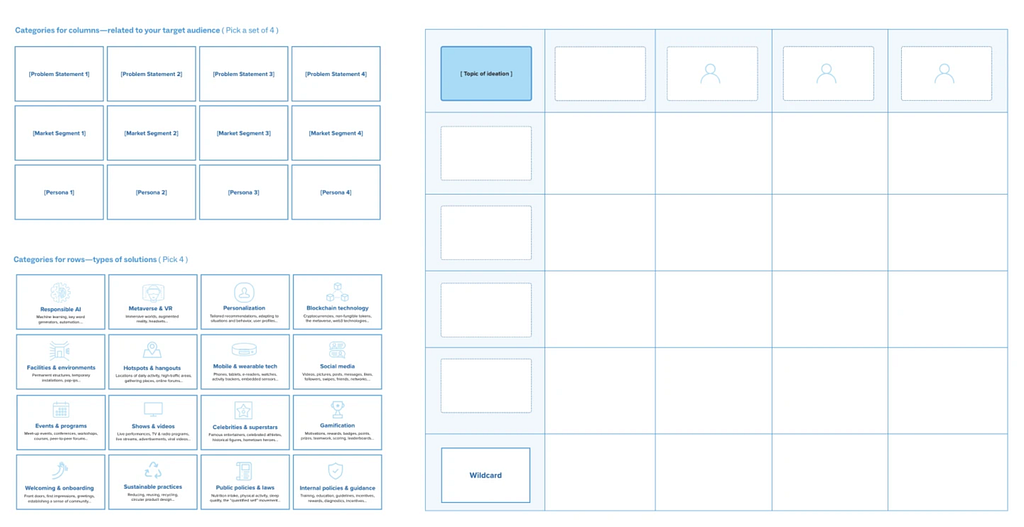
The Creative Matrix, designed by the Mural, is a simple but powerful tool for structured brainstorming. It forces you to think in multiple directions by mixing customer needs with technology solutions — helping you generate ideas that are both creative and practical.
Step 1: Define Your Customers and Their Problems
Start by choosing four customer types or market segments you want to focus on. Then, define a key problem for each one.
For The Example, We Will Narrow It Down To One:
- Customer Persona: Small business owners
- Problem: Struggling to keep up with Instagram posts due to time constraints and lack of design skills.
Step 2: Cross-Apply Technologies
Now, pick four technologies or trends that could solve these problems. Think broadly — AI, automation, blockchain, whatever is relevant to your industry.
Example tech categories:
- AI & Machine Learning
- No-Code Automation
- Augmented Reality
- Data Analytics
Step 3: Fill Out the Matrix with Ideas
Now, brainstorm ways each technology could solve each problem. This isn’t about perfection — it’s about volume.
Example:
Customer Persona: Small business owners struggling with social media Intersects with Technology: AI & Machine Learning
To:
- Idea 1: Create AI-generated hashtags and captions
- Idea 2: Auto-schedule posts based on engagement data
- Idea 3: AI-driven content recommendations based on audience trends
- Idea 4: AI-generated social media content for small business owners
By the end, you’ll have a structured list of ideas that are actually grounded in customer needs and technological feasibility.
📊 Part 3: The Market-Driven Gut Check
Great — you’ve got a bunch of ideas. Now it’s time to separate the “maybe” from the “no way.”
Instead of spending time on a lengthy scoring system, let’s cut straight to the essentials — Market Size, Pain, and Frequency. These three factors determine whether an idea has enough demand to be worth pursuing.
How the Market-Driven Gut Check Works (With Simple Numbers):
Market Size (in millions): Estimate the total number of potential users, rounded to the nearest million (e.g., 1M, 2M, 10M). Bigger markets mean more opportunity.
Pain Level (1–10): There is no perfect scale but rate how painful the problem is. Use research, user interviews, or surveys to validate this number.
- 1 — (I tsk when it happens, and then move on),
- 5 — (Causes low-grade anxiety),
- 10 — (I would sacrifice my firstborn baby on the altar of Beelzebub to make this go away….. okay, maybe not that far, but you get it)
Frequency (1–5): 1 = Yearly, 2 = Monthly, 3 = Weekly, 4 = Daily, 5 = Hourly. The higher the frequency, the bigger the opportunity.
Example Market Gut Check:
- Idea 4: AI-generated social media content for small business owners
- Market Size: ~5M users
- Pain Level: 6/10 (Frustrating but not a business killer)
- Frequency: 4 (Daily usage, strong demand signal)
- Validation Score — 5x6x4 = 120 Gut Checkpoints.
Verdict: Worth exploring, but success depends on high-quality automation and differentiation from existing tools.
Personal Note: “Anything over 100 Gut Checkpoints is worth further validation. If it’s under 100? Move on and keep looking; the world is full of unmet needs of clever people like yourself.”
🎯 Conclusion: From Ideas to Execution
Good ideas often don’t appear out of nowhere. The best ones come from structured creativity and repetitive validation.
- The Creative Matrix helps generate ideas that are customer-focused and technology-backed.
- The Market-Driven Gut Check helps filter out ideas that aren’t worth pursuing before investing time and resources.
So before you build anything, try this:
- Generate 20+ alternative ideas using the Creative Matrix.
- Run them through the Market-Driven Gut Check (Market Size, Pain, Frequency).
- If your original idea still holds up, go for it, but maybe you will find out your good Idea was just meh, and that's okay!
Because execution is everything — but only if you’re building something people actually want. 🚀